2 Days in Copacabana on Lake Titicaca in Bolivia
Ideally located between Cuzco and La Paz, Copacabana is a choice stopover for travelers wishing to discover Lake Titicaca, on whose shores the town is situated.
Ideally located between Cuzco and La Paz, Copacabana is a choice stopover for travelers wishing to discover Lake Titicaca, on whose shores the town is situated. A religious destination that attracts pilgrims from around the world, it is also the ideal starting point for exploring Isla del Sol and Isla de la Luna. Discover all the things to do in Copacabana in 2 days.
Be careful not to confuse the Bolivian town of Copacabana with the neighborhood and beach of Copacabana in Brazil !
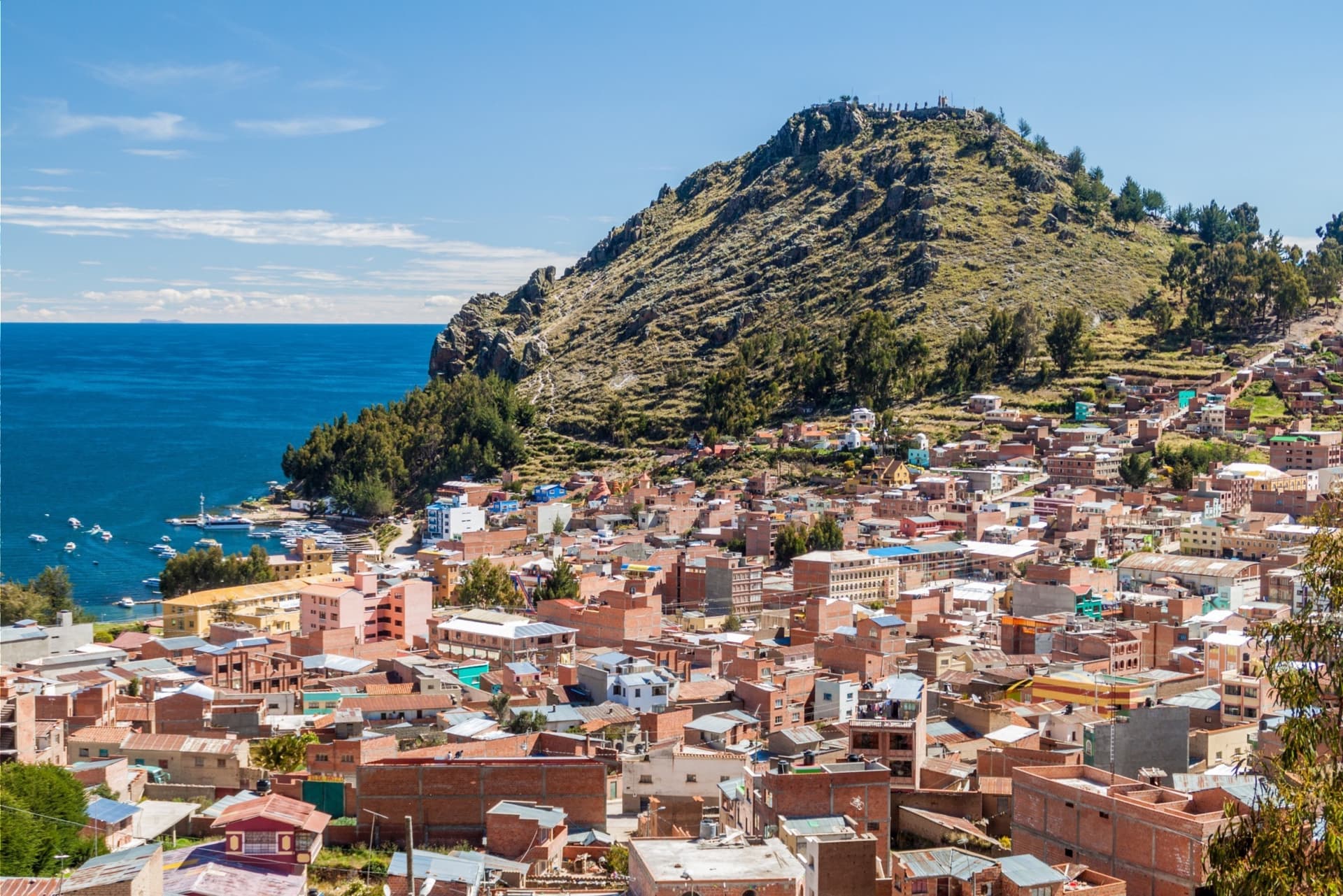
In Brazil, Copacabana is a neighborhood in Rio de Janeiro, famous for its beach and sultry atmosphere. The town of Copacabana in Bolivie, on the other hand, is a small hamlet with a tranquil atmosphere, nestled between two hills and perched at 12,600 feet altitude. Two places, two very different vibes then!
Day 1 : Discovering the Town Center
Strolling through the town center to the shores of Lake Titicaca

The town of Copacabana is easily explored on foot. For a first approach, we recommend starting from its nerve center : Avenida 6 de Agosto. This is where you'll find most amenities (cafés, restaurants, shops, hostels...).
At the corner of Pando and Jauregui streets stands Copacabana's market, where you'll find fresh produce and numerous local specialties. A chance to immerse yourself in local culture and meet the locals. You'll notably encounter the Cholitas, Bolivian indigenous women belonging to the Aymara people, easily recognizable by their traditional attire (a ruffled skirt and bowler hat).
Continue your exploration by heading down the avenue to reach the region's major site : the unmissable Lake Titicaca. On the shores of the lake, you'll find a few restaurants. Don't miss local culinary specialties such as trucha, salmon trout fished directly from the lake !
Lake Titicaca in a nutshell...
Formed during the preglacial period approximately 60 million years ago, Lake Titicaca is South America's largest freshwater lake in terms of both volume and surface area. Considered the cradle of Incan civilization, Lake Titicaca is, according to local beliefs, the place where the first Inca, Manco Capac, and his companion Mama Ocllo emerged from its depths to appear on Isla del Sol with the aim of building an empire on Earth.
Visiting the unmissable Basilica of Our Lady of Copacabana

Once on the shores of the lake, head to the region's most important building : the Basilica of Our Lady of Copacabana. Also called the "Basilica of the Virgin of Candelaria," it is known for housing the Virgin of Copacabana. For indigenous peoples, the Virgin of Copacabana represented an Incan princess. Today, she is regarded as the patron saint of Bolivie, a source of good fortune. Pilgrims undertake long journeys across the country to come and see her.
With its colonial architecture, the building is characterized by numerous domes and roofs covered with colorful tiles. Inside, there is a small museum displaying paintings of European origin and religious artworks.
Don't miss: at dawn, you can witness a unique and atypical ritual held in front of the cathedral : the Bendición de movilidades (which can be translated as "blessing of vehicles"). This is a procession of new vehicles decorated by their owners who come here to receive an anointing with beer or champagne !
Taking in the Heights at Cerro El Calvario to Admire the Sunset

Continue your exploration to Cerro El Calvario, another important place of worship for locals, situated atop a hill. Translated as "Hill of Calvary," it is a pilgrimage route recreating the seven stops of Jesus on the way to his crucifixion. Many pilgrims undertake this approximately 30-minute ascent in homage to Jesus's suffering.
At the summit, there is an altar with a representation of his crucifixion, as well as numerous healers who perform healing rituals. Along the way up, you can purchase miniature trucks and houses that can be blessed at the summit to come to life.
Whether you are a believer or not, the ascent is truly worthwhile to enjoy breathtaking views of Lake Titicaca, Copacabana Bay, and the surrounding area. It is recommended to go at sunset.
Being a very important place of worship, Cerro El Calvario is frequented by many pilgrims, particularly on Good Friday and Easter Sunday. Don't be surprised if you see locals queuing to pray and make offerings in front of each cross leading to the summit.
Good to Know
Regarding the ascent, it is not considered difficult but can be challenging due to the altitude. Find all our tips for avoiding acute mountain sickness (AMS) during a trip to Bolivie.
Day 2 : Exploring the Lake's Islands
Venturing on an Excursion to the Island of the Sun (Isla del Sol)

Accessible by a two-hour boat ride from Copacabana, Isla del Sol is the highlight of any visit to Lake Titicaca. It is the largest of the lake's islands and one of the most sacred. And for good reason—it is here, according to local belief, that the first Inca, Manco Capac, emerged from its waters. During the Incan era, the island was a sanctuary containing a temple with virgins dedicated to the sun god, or Inti.
Inhabited for centuries, the island's residents are mostly of Aymara and Quechua origin. On this island where motorized vehicles are prohibited, you'll enjoy a peaceful atmosphere where it's pleasant to wander under the sun.
Among the sites of interest not to be missed on Isla del Sol, you can note :
Chequesan Hill : at an altitude of 13,350 feet, you can climb it to enjoy a panoramic view of the lake and the region.
The ruins of Palacio de Pilkokaina, a two-level palace that is said to have been built by the Incan emperor, Túpac Inca Yupanqui.
The village of Challapampa where you'll find the Chinkana labyrinth, an ancient training center for Incan religious guides.
Titi Kharka (Puma Rock), a site once used for human sacrifice.
The village of Yumani from which you can descend 206 steps to reach the legendary Yumani Fountain of Youth.
Venturing on an Excursion to the Island of the Moon (Isla de la Luna)

The second sacred island of the Incas after Isla del Sol, Isla de la Luna owes its appeal to its pre-Hispanic agricultural terraces as well as the remains of the former Incan temple Iñakuyu, the Palace of the Virgins of the Sun.
To tell the story, the site was reserved exclusively for women and only the Incan emperor could visit. It is said that the women led a religious life there, holding ceremonies in honor of the sun and moon and learning textile crafts (notably the making of alpaca wool clothing). According to legend, some were chosen to become the emperor's concubines, while others were offered as sacrifices during the full moon...
Practical Information
Please note : if you wish to discover both islands, we recommend dedicating at least two days to it, spending one night on Isla del Sol.
Frequently asked questions
From La Paz, Copacabana is accessible by bus in approximately 3 to 4 hours. Several companies offer regular departures from the Cemetario terminal. The journey includes a barge crossing of the Tiquina Strait. Tickets typically cost between 3 and 5 USD.
Boats to Isla del Sol depart regularly from Copacabana's port. Round-trip tickets generally cost between 3 and 6 USD depending on the company. The journey takes approximately 2 hours to the northern part of the island.
The best time to visit Copacabana is the dry season, from May to October. The skies are generally clear, ideal for enjoying views of Lake Titicaca. Avoid the rainy season (November to March) which can make excursions less pleasant.
Yes, it is possible to spend a night on Isla del Sol in one of the many hostels and small hotels available in the villages of Yumani and Challapampa. It is even recommended if you wish to visit both islands (Isla del Sol and Isla de la Luna) in 2 days.
Copacabana is situated at 12,600 feet altitude, which can cause acute mountain sickness (AMS) in some travelers. It is advisable to plan one to two days for acclimatization, drink plenty of water, avoid alcohol for the first few days, and take your time during climbs such as Cerro El Calvario.
The Bendición de movilidades is a unique ritual that takes place each morning in front of the Basilica of Our Lady of Copacabana. Owners of new vehicles come to have their cars blessed by a priest, decorating their vehicles and receiving a sprinkling of beer or champagne. This ritual blends Catholic beliefs with Andean indigenous traditions.