Climbing Irruputuncu Volcano
Climbing Irruputuncu Volcano
Irruputuncu is a small active stratovolcan in the Andes Cordillera, located between Chile and Bolivie, in the Potosi Department. It is part of the Central Volcanic Zone
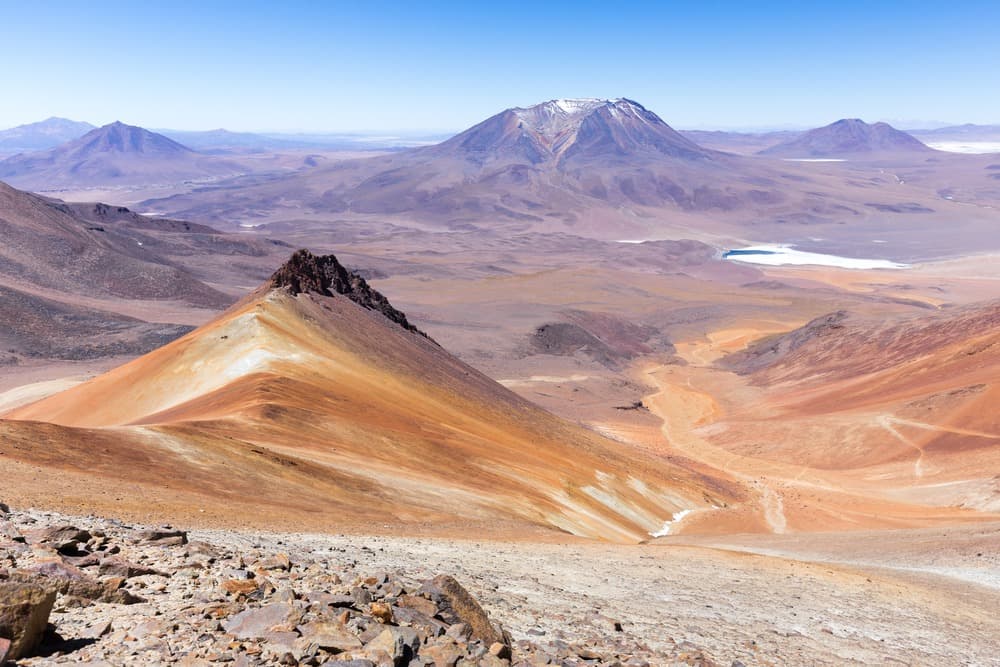
Irruputuncu is a small active stratovolcan of the Andes Cordillera, located between Chile and Bolivie, in the Potosi Department. It is part of the Central Andes Volcanic Zone (CVZ). Its summit, standing at 5,165 m, features two craters. Several lava domes and active fumaroles are scattered around it. Below, you'll find thermal springs, an ideal spot for a restorative break. Nestled within calm nature, the entire landscape takes on a mythical character. Irruputuncu sits near Ollagüe (5,868 m), another active volcano distinguished by its snow-capped peaks.
Seeking adventures off the beaten path? Don't hesitate to choose an ascent of Irruputuncu during your stay in the Lipez region.
History
Irruputuncu takes its name from a spiny Peruvian feather grass "iru" and a structure designating a hole, crevasse, or crater, "phutunqu". It is also called Irruputunco or Iruputuncu. Its formation resulted from a succession of eruptions that filled a fissure caused by the collapse of the Earth's crust. Gigantic eruptions confirmed the volcano's activity, observed millennia before Christ. The first recorded eruption dates to November 26, 1995, followed by another on September 1, 2003. According to studies conducted by scientists, ongoing seismic activity releases approximately 21 to 50 tons of sulfur dioxide daily. This explains the presence of sulfurous deposits in the crater.
Research has led to quite conclusive findings. There is discussion of a possibility of geothermal energy production from this volcano. Today, Irruputuncu is monitored by the Chilean geological service SERNAGEOMIN.
Characteristics of Irruputuncu
This massif, still little known to visitors, presents a striking appearance with its lava flows and thick layers of magma. It offers thrill-seekers the chance to meet challenges. This involves scaling several meters of elevation gain to reach the first stage of the ascent. Upon arrival, an astonishing landscape unfolds, created by a thick cloud of vivid yellow smoke rising from a sulfur mine, 150 m high. If the wind manages to disperse this enormous vapor, it's possible to reach the summit where a breathtaking view of the surrounding lagoons extends. Be prepared—the climb requires excellent physical condition due to the altitude and glacial climate.
Sensational Discoveries in South Lipez
Continuing the journey will allow travelers to explore other facets of the region. Within the Altiplano, a circuit combining treks and ascents leads to other Andean volcanic massifs that rival each other in beauty. Besides Irruputuncu, three others are well worth the detour. There is Tunupa, peaking at 4,700 m. At the top extends a sublime view of the Salar d'Uyuni and its surroundings. Next comes Llicancabur, rising to an altitude of 5,960 m. Ascending it requires certain technical skill to reach the summit. Urutuncu offers a very easy approach route, though it approaches 6,000 meters in height.
Take the trail leading toward Irruputuncu, departing from the village of San Pedro de Quemez.
Give it a go!
Our local experts arrange this activity for you.