Sacred Valley of the Incas
Sacred Valley of the Incas
Agricultural heart of the Inca Empire near Cusco, the Sacred Valley aligns archaeological sites, Andean villages and cultivated terraces leading to Machu Picchu.
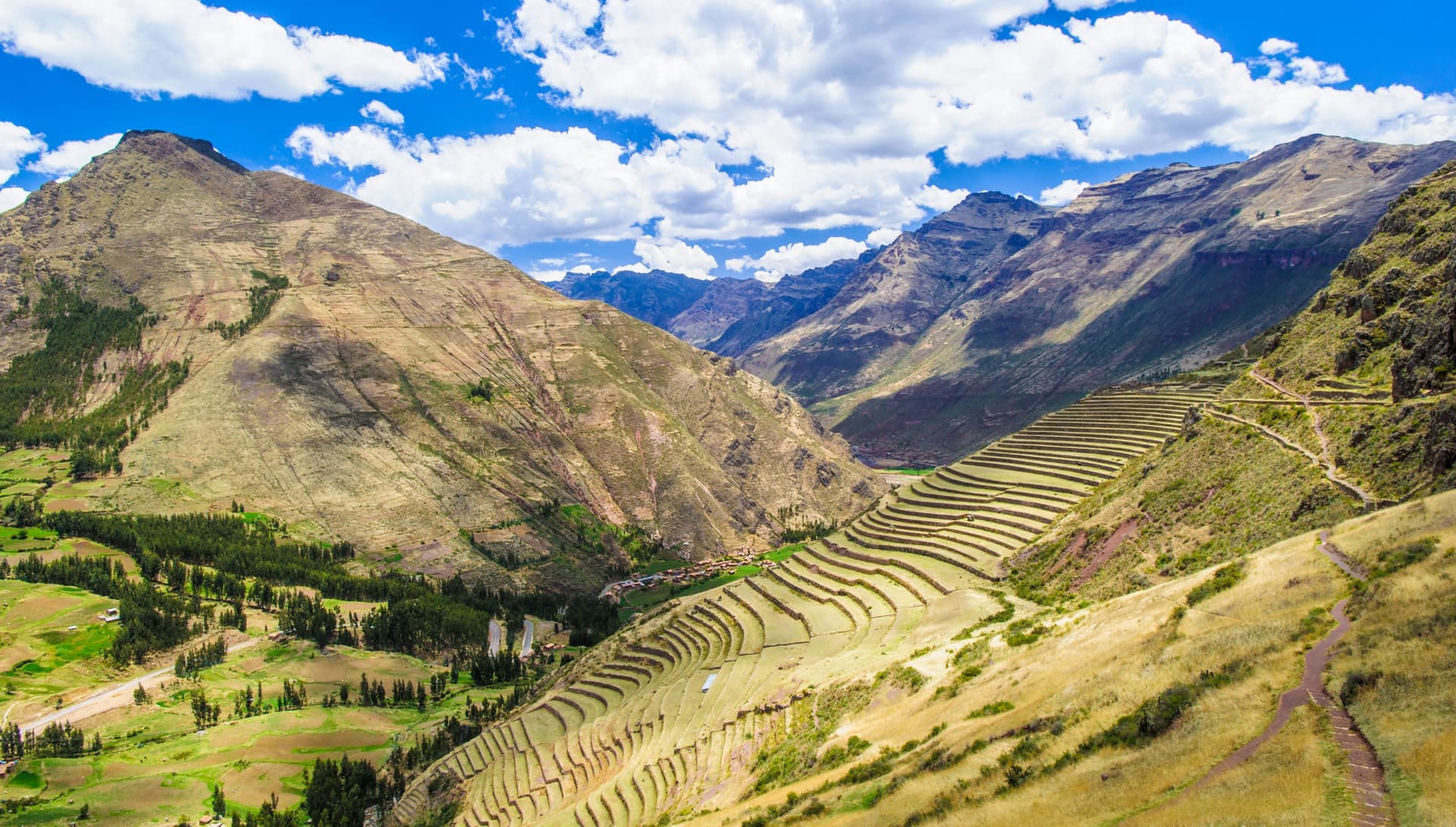
The Sacred Valley of the Incas stretches along the Urubamba River, between Pisac and Ollantaytambo, about thirty kilometres north of Cusco, Peru. Agricultural heart of the Inca Empire thanks to its temperate climate and fertile soils, it preserves a remarkable alignment of archaeological sites, Andean villages and terraces still under cultivation. It is also the natural corridor leading to Machu Picchu.
Why visit the Sacred Valley
The valley concentrates, over a hundred kilometres, several major sites of Inca civilization: Pisac and its artisanal market, Ollantaytambo and its military terraces, Moray and its circular basins, Maras and its salt pools. All of this can be explored in one to three days from Cusco, at lower altitudes (2,800 to 3,000 m) than the imperial capital, which helps acclimatization before the ascent to Machu Picchu.
Beyond the ruins, the villages perpetuate Andean daily life where Quechua remains the language of everyday use, where weaving cooperatives still work with plant dyes, and where the cultivation of giant white corn gives rise to chicha, a fermented beverage used in ceremonies since pre-Columbian times.
History
Before the Incas, the valley was occupied by pre-Hispanic Andean communities. It was conquered under the reign of Emperor Pachacutec in the 15th century, who made it Cusco's grain store. The mild climate allowed intensive corn cultivation and the production of chicha, a fermented beverage used in religious ceremonies.
The Incas undertook vast construction projects: terraced agricultural fields, irrigation canals, temples and fortified cities like Ollantaytambo and Pisac. The experimental site of Moray served as an Inca agricultural research centre, where temperature variations between levels allowed seeds to be acclimatized.
The arrival of Spanish conquistadors in the 1530s disrupted local organization. Fertile lands were redistributed, and several temples replaced by colonial churches. Some sites, such as Ollantaytambo, however resisted Spanish assaults. Current communities continue to occupy the valley and cultivate the same terraces as five centuries ago.
What to see in the Sacred Valley
Pisac
33 km from Cusco (about 45 minutes by road), Pisac marks the eastern entrance to the valley. The village is known for its artisanal market and for the archaeological site perched above, whose agricultural terraces cascade down the cliff face. Pisac also serves as the starting point for the Kinsa Coche trek, which leads to a cluster of high-altitude lagoons that see few visitors.
Urubamba
Historically considered a major centre of white corn cultivation, Urubamba is today the liveliest town in the valley and a convenient logistical base. From here, two classic excursions: the salt mines of Maras, whose thousands of terraced basins produce between 150 and 200 tonnes of salt per year, and Moray, the Inca experimental agricultural site with concentric basins.
Ollantaytambo
Ollantaytambo is the only Inca village to have preserved its original urban plan, with its canchas (residential blocks) still inhabited. The archaeological site overlooking the town combines an unfinished Temple of the Sun, a still-functional irrigation system and terraces that also served as a defensive structure: it was here that Manco Inca's troops repelled a Spanish charge in 1537.
Chinchéro
28 km from Cusco and at 3,772 m altitude, Chinchéro offers a panoramic view over the valley and the Vilcabamba mountain range. The village is dominated by the colonial Church of Nuestra Señora de Monserrat, built in the 17th century on the foundations of an Inca palace. It is also the starting point of an ancient Inca road that descends to the hamlet of Urquillos, in four to five hours of walking.
Yucay
Yucay was the residence of sovereigns Tupac Inca Yupanqui and Huaynacapac. The village preserves the terraces of Pacaypata, which extend over a hundred metres and are among the most vast in the surroundings of Cusco, as well as the Antibamba gateway where a sacred mythological stone is found. The Living Culture Museum offers an insight into local textile, agricultural and culinary traditions.
Machu Picchu
Machu Picchu, at 2,430 m altitude, does not strictly lie within the valley but constitutes its natural outlet. The citadel illustrates Inca construction expertise: stones cut and assembled without mortar, structures that have withstood earthquakes for five centuries, and the Intihuatana stone which served as a solar calendar — its shadow disappears at the equinoxes.
Sports and activities
- Inca Trail: 39 km trek between Ollantaytambo and Machu Picchu, over four days, with government quota and reservation several months in advance.
- Maras Zip-lining: circuit of four cables, the longest reaching 1,250 m, above the salt mines landscape.
- Rafting on the Vilcanota River: descent of 1 to 2 hours between Urubamba and Ollantaytambo, varying levels depending on experience.
- Cycling: descent from Abra Málaga (4,316 m) to Ollantaytambo (2,792 m), accessible to intermediate cyclists.
- ATV on the Chinchéro – Maras – Moray circuit, and rock climbing in the Pachar sector, near Urubamba.
Practical information
Most sites are covered by the Cusco Boleto Turístico, a combined ticket valid for several days. Machu Picchu must be booked separately, ideally several weeks in advance. Allow a minimum of one day for a quick overview (Pisac + Ollantaytambo on an organized tour) and three to four days to explore the whole area without rushing.
Altitude remains reasonable (between 2,800 and 3,000 m in the valley floor), but Chinchéro rises to 3,772 m. One to two days of acclimatization in Cusco before sustained effort is recommended.
When to go
The dry season runs from April to October: clear skies, mild daytime temperatures and cool nights, ideal conditions for hiking. It is also the peak tourist season, particularly from June to August. The rainy season, from November to March, sees frequent showers but lush vegetation, fewer crowds and more flexible rates. The Inca Trail is closed in February for maintenance.
How to get there
By bus
Regular buses depart from Cusco's main bus terminal to Urubamba, Ollantaytambo and Pisac. This is the most economical option, with high frequencies during the day.
By taxi or private car
A taxi from Cusco allows you to combine several sites in the same day. Rates vary depending on distance and number of passengers; negotiate the price before departure or arrange through your accommodation.
By train
PeruRail and Inca Rail companies connect Cusco (Poroy station) and Ollantaytambo to Aguas Calientes, at the foot of Machu Picchu. This is the only way, other than trekking, to access the citadel.
Nearby sites
If you extend your Andean exploration, several destinations complement this circuit. The Tatio geysers offer another face of the high plateau, as does the Valley of the Moon near La Paz. Further south, the Cerro Rico mines in Potosí and the Chapare Valley testify to other facets of the Andean world.
Frequently asked questions
Frequently asked questions
One day is enough for an overview (Pisac + Ollantaytambo on an organized tour), but three to four days are recommended to include Maras, Moray, Chinchéro, Yucay and Machu Picchu without rushing.
Staying in Urubamba or Ollantaytambo has two advantages: lower altitude, so better acclimatization, and quick access to the Machu Picchu train from Ollantaytambo.
Geographically, Machu Picchu lies downstream of the valley, in a cloud forest area. However, it constitutes its logical extension and most itineraries include it.
No. The trail is closed in February for maintenance and permits are limited: you must book several months in advance, especially for the dry season.
The months of April and May combine clear skies and landscapes still green after the rains, which gives the most interesting contrasts.
To include the Sacred Valley in a tailor-made Andean circuit, consult our travel ideas.
Interested in this visit?
We can include it in your personalised itinerary.