Island of the Sun
Island of the Sun
The mythical cradle of the Inca empire, Isla del Sol blends pre-Columbian ruins, high-altitude trails, and Aymara villages in the heart of Lake Titicaca.
Here's the crowning highlight of a journey to Lake Titicaca! Beach pleasures, encounters with traditional communities, visits to pre-Columbian ruins, hiking through the hills, and more all await you at Isla del Sol.
History
The research of chronicler Bernabé Cobo led to two versions of an Inca legend born in the island's northern region. Tradition recounts that the first Inca Manco Cápac came into the world upon a prominent rock at the time of Titi Qala. He is said to have been the son of the Andean sun deity Intila. Another myth tells that in ancient times, darkness covered the province for several days. When the sun emerged from the rock in the middle of the lake, inhabitants believed it was the dwelling place of Intila. Isla del Sol gradually formed as floodwaters receded and the luminous celestial body rose back into the sky. A temple was erected on this fragment of land—a sacred building that the 10th Inca Tupac Inca Yupanqui later expanded. He also had a tambo (inn) constructed for pilgrims, as well as a convent for the mamaconas, women selected according to various criteria.
In Aymara culture, the island is called Titi'kaka. The original meaning of the name remains unknown. According to certain researchers and linguists, the word may derive from the terms titi and gala, designating respectively "an Andean mountain cat" and "a rock." The expression Tahksi kala appears in Ludovico Bertonio's Aymara-Spanish dictionary (1612) and translates to "Piedra foundacional" or "foundation stone."
Today
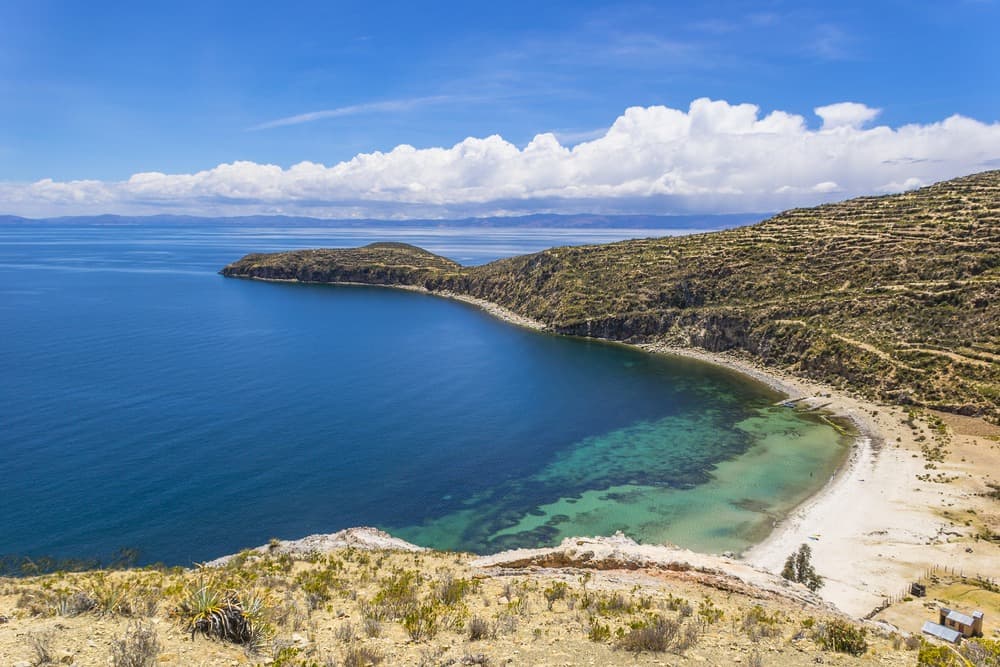
In the Andes Mountain range, the largest of Lake Titicaca's islands, stretching 9.6 km in length and 4.6 km in width, breathes tranquility. Isla del Sol is a haven of peace where it's wonderful to wander under the sun, far from engine noise. For panoramic views, climb Chequesan hill, which peaks at 4,070 meters of altitude—260 meters above the lake's surface. The island's inhabitants are mostly of Aymara and Quechua descent. They live from agriculture, fishing, handicrafts, and tourism work as guides.
Discovering Isla del Sol
On the Island of the Sun, motorized vehicles are forbidden. There are no paved or asphalt roads either. Inhabitants travel mainly on foot and rely on mules for transporting goods. Tourist boats make only two trips per day, though you can ask fishermen to take you on small excursions.
To fully appreciate the lake and island's charms, plan for one or two days. With a half-day excursion, your discovery would be limited to the boat journey and a brief stop at the southern tip. Devoting a full day allows you to enjoy the journey between Copacabana and Challapampa, visit the Museo de Oro, take a tour of Isla de la Luna, explore the town of Yumani, hike to the sacred site of the Puma Rock, and more.
Near the Puma Rock, you'll find a low stone platform tinted in red. This is the Inca Table, once used for human sacrifice rituals. Nearby, marvel at the natural engravings of the "Steps of the Sun" carved into the rock. In southern Isla del Sol, at Yumani, Inca steps lead down to the lake's water. Take time to admire the fountain of youth. Then visit the temple of Pilcocaina before enjoying a refreshing swim in Lake Titicaca. Along the paths, you'll frequently encounter herds of llamas and donkeys, as well as adobe brick structures. As day winds down, settle at a restaurant table on the island to watch the sunset in all its splendor. After nightfall, under clear skies, constellations—notably Arco Iris and the Southern Cross—will captivate your gaze.
Climate
Located in the Lake Titicaca region, Isla del Sol experiences a dry, cold climate with a brief rainy period between December and January. The following months are generally sunny and dry, with cool, windy nights. Throughout the year, temperatures range from 7°C to 20°C, but can drop to −1°C in winter. Snow is possible at certain times.
To reach Isla del Sol, you need a boat. In Copacabana, numerous tour operators offer half-day excursions, and you can also hitch a ride from the shores of Yampupata at the island's northern tip. Boats depart from Copacabana's port at 8:30 a.m. and 1:30 p.m. Return trips are scheduled for 1:30 p.m. from Challapampa and 4 p.m. from Yumani. Be sure to verify schedules.
On Isla del Sol, tourists and locals move about mainly on foot. Moreover, the island isn't very large. If your bags are heavy, you can rent a donkey to carry them.
What to Do on Isla del Sol?
- Refresh yourself at the fountain of youth in Yumani
- Take panoramic photos from the Puma Rock
- Visit the ruins of Pilcocaina temple
- Contemplate the natural impressions of the "Steps of the Sun"
- Take an excursion to Isla de la Luna, and more
Want to discover this destination?
Our local advisors design your tailor-made trip.