La Paz Cemetery
La Paz Cemetery
National necropolis and repository of funerary art, La Paz's general cemetery brings together military heroes, artists and Andean traditions of death.
The Cementerio General de La Paz holds a singular place in Bolivia's capital. At once a national necropolis, a conservatory of funerary art and a place of collective memory, it gathers within the same space military heroes, political figures and artists who have shaped the nation's history. A visit here illuminates Bolivian art as much as the particular relationship Andean culture maintains with death.
Why visit La Paz's general cemetery
Three main reasons justify a detour to this site, situated between the historic centre and the heights of El Alto:
- A diverse architectural heritage, blending mausoleums carved into rock, neoclassical and neo-Gothic monuments, and ornaments drawing on Italian inspiration (Christs, Madonnas, angels).
- A concentrated national memory: combatants of the War of the Pacific, heroes of the Acre War, writers, musicians and journalists rest here.
- A living reading of Bolivian funerary traditions, particularly during Día de los Muertos, when the atmosphere draws closer to celebration than contemplation.
Bolivian street art has also found its place here, creating an unexpected dialogue between contemporary murals and ancient statuary.
History of the cemetery
The site was born by supreme decree of Marshal Antonio José de Sucre, signed on January 25, 1826, shortly after Bolivian independence. Official inauguration took place several years later, on January 24, 1831, under the signature of Marshal André de Santa Cruz, then President of the Republic.
Before its creation, colonial custom reserved church interiors for notable Spaniards and Creoles, while indigenous and mixed-race peoples were buried in church atriums. The new general cemetery ended this funerary segregation by bringing burials together in the same civic space.
The General Regulations for Cemeteries, approved on February 9, 1940, set the rules still in force today: graves are leased for ten years, after which remains are either cremated or transferred to smaller niches. Perpetual grave ownership exists, but its cost—equivalent to ten times the average Bolivian monthly salary—reserves it for a minority.
What to see on site
The site covers a vast expanse, equivalent to roughly fifteen city blocks. Entry is through a large archway, beyond which lie the main church and crematorium.
Military mausoleums
The mausoleum of combatants from the War of the Pacific (1879), a conflict that pitted Bolivia against Chile and cost it its ocean access, is dominated by a marble soldier. At its feet, the inscription "Reivindicad el Litoral" ("Reclaim the Coastline") recalls the enduring wound of a country stripped of maritime borders.
The mausoleum of the Acre War (1899-1903), a territorial conflict with Brazil, is built in granite and houses a golden statue of Christ.
Political and religious figures
The tomb of Jesuit priest Luis Espinal, assassinated in 1981, bears the inscription "martyr of democracy." His figure remains a symbol of resistance against dictatorship.
Artists and intellectuals
Several major personalities of Bolivian culture rest here in individual tombs:
- Jaime Sáenz Guzmán (1921-1986), narrator and poet.
- Oscar Gonzalez Alfaro (1921-1963), writer devoted to children's literature.
- Carlos Palenque Aviles, known as El Compadre (1944-1997), musician and television presenter who became a political figure.
- Franz Tamayo (1879-1956), central poet of twentieth-century Bolivian literature.
- Gilberto Rojas Enríquez (1916-1983), composer of the celebrated "Viva Santa Cruz", the second anthem of the Santa Cruz department.
Architecture and funerary art
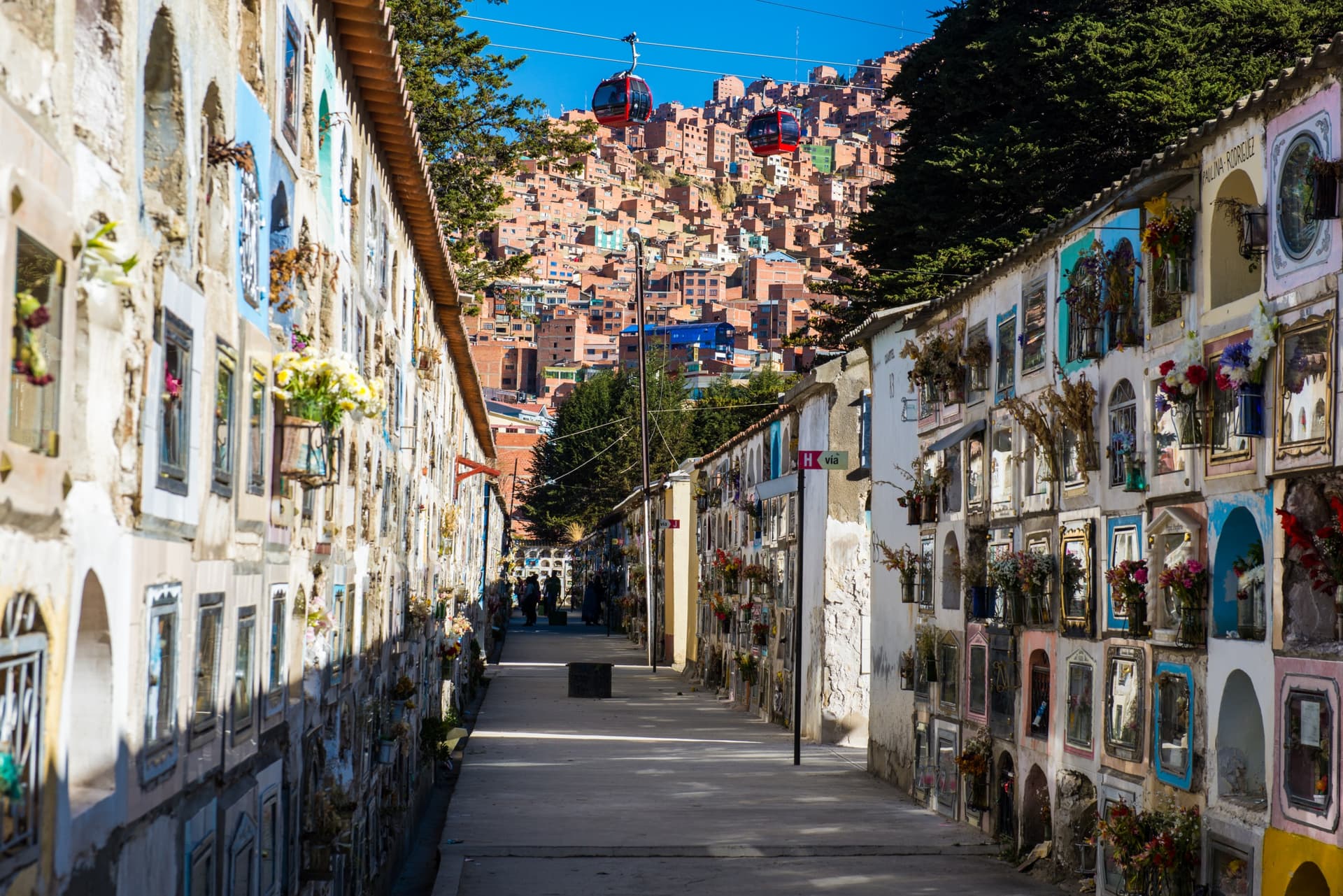
Tombs are generally not buried in earth but stacked in buildings, forming walls of niches. Each burial appears as a small glass-fronted sanctuary into which families place flowers, photographs and objects dear to the deceased, meant to accompany them in their transition to the afterlife. The most carefully adorned monuments are recognized as genuine works of art and form the backbone of guided tours offered on site.
When to visit
The cemetery is open for visits year-round. The highlight, however, remains Día de los Muertos, on November 2nd. Families settle before the tombs to share the favourite dishes of the departed, musicians play in memory of the absent, people sing and raise toasts. The atmosphere is festive, far removed from the silent contemplation of European cemeteries. For those wishing to understand the Andean relationship with death, this is the date to mark.
Outside this day, weekday mornings offer quieter visits, ideal for photography and reading inscriptions.
Practical information
- Address: Avenida Baptista, at the edge of La Paz's historic centre.
- Hours: open during the day, closing in late afternoon. Check on site for seasonal hours.
- Fee: free entry. Thematic guided tours (funerary art, notable figures, traditions) are available for a modest fee.
- Dress code: appropriate attire recommended; the site remains an active place of mourning.
- Safety: favour times of high foot traffic and avoid isolated areas of the cemetery late in the day.
How to get there
Two main options from central La Paz:
- Cable car: the red line serves Estación Teleférico Cementerio, located opposite the cemetery's rear entrance. The ride offers a sweeping view of the city.
- Taxi: the most direct option from city centre hotels; a short ride.
In front of the cemetery, a bus stop also serves Tiwanaku and Copacabana, on the shores of Lake Titicaca, making it a convenient departure point for excursions to the northwest of the country.
What to see nearby
The cemetery fits naturally into a curated journey through La Paz and its surroundings:
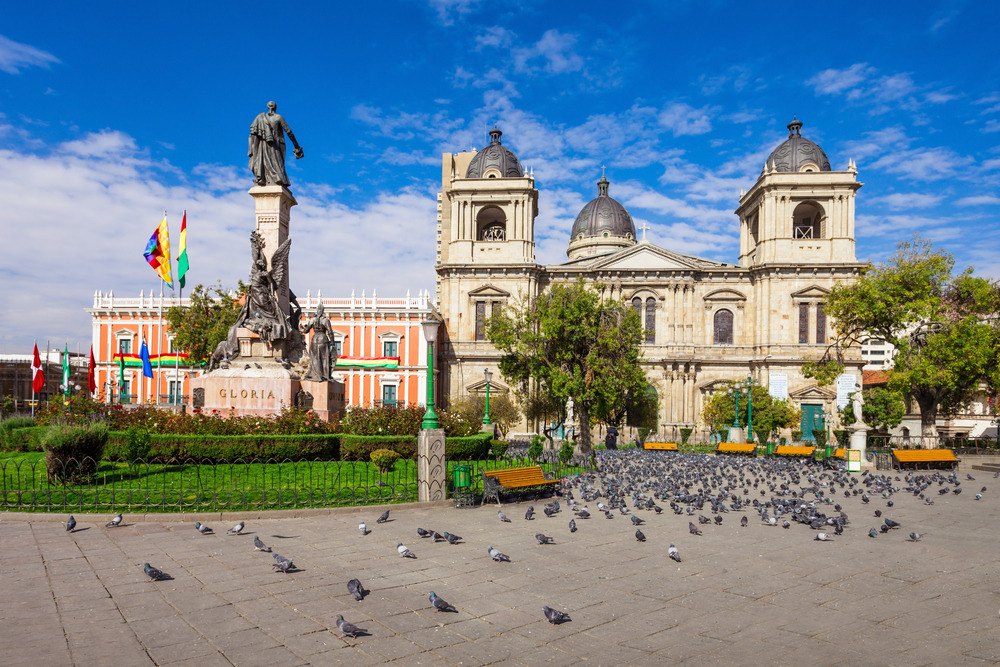
- The historic centre of La Paz, with Murillo Square, Jaén Street and the Witches' Market.
- A cable car ascent to El Alto to grasp the scale of the agglomeration.
- To extend the historical journey, the Casa de la Libertad in Sucre, where the declaration of independence was signed.
- On the archaeological heritage side, the chullpas of Pumiri bear witness to other Andean funerary traditions.
- For those interested in industrial and social history, the mines of Cerro Rico in Potosí.
Frequently asked questions
Frequently asked questions
Yes, access to the site is free. Only thematic guided tours carry a charge, at a reasonable rate.
No strict requirement, but appropriate attire is recommended. The cemetery remains an active place of mourning where families visit daily to pay their respects.
Yes, especially to understand the symbolism of military mausoleums, identify the graves of major Bolivian figures and grasp the codes of local funerary art. Without a guide, much goes unnoticed.
On November 2nd. This is the busiest time of year in the cemetery, with family picnics before the tombs, musicians and food offerings.
Plan on one to two hours for a self-guided tour, or more with a guide or if you photograph the funerary art.
Incorporating the cemetery into your itinerary
A memorable stop easily combined with exploration of La Paz's historic centre and a cable car ride up to El Alto, the general cemetery deserves a place in a broader circuit through Bolivia. To build a custom itinerary incorporating La Paz, Sucre, Potosí and Lake Titicaca, consult our trips to Bolivia.
Nearby
Interested in this visit?
We can include it in your personalised itinerary.